



Temperature Data Logging for Nut Roasting and Frying
Temperature Data Logging for Nut Roasting and Frying
Measure the actual temperature profile experienced by nuts during continuous roasting and frying processes in hot oil.
Nut roasting, coated nut production and similar food-processing applications often use a continuous process in which the product travels through an industrial fryer or roasting oven containing hot oil. This also applies to normal frying, such as french fries and other foods.
For process optimisation and temperature validation, it can be valuable to allow a temperature data logger to travel through the process together with the product. The logger follows the same path as the nuts and records the actual temperature conditions experienced during the frying or roasting process.
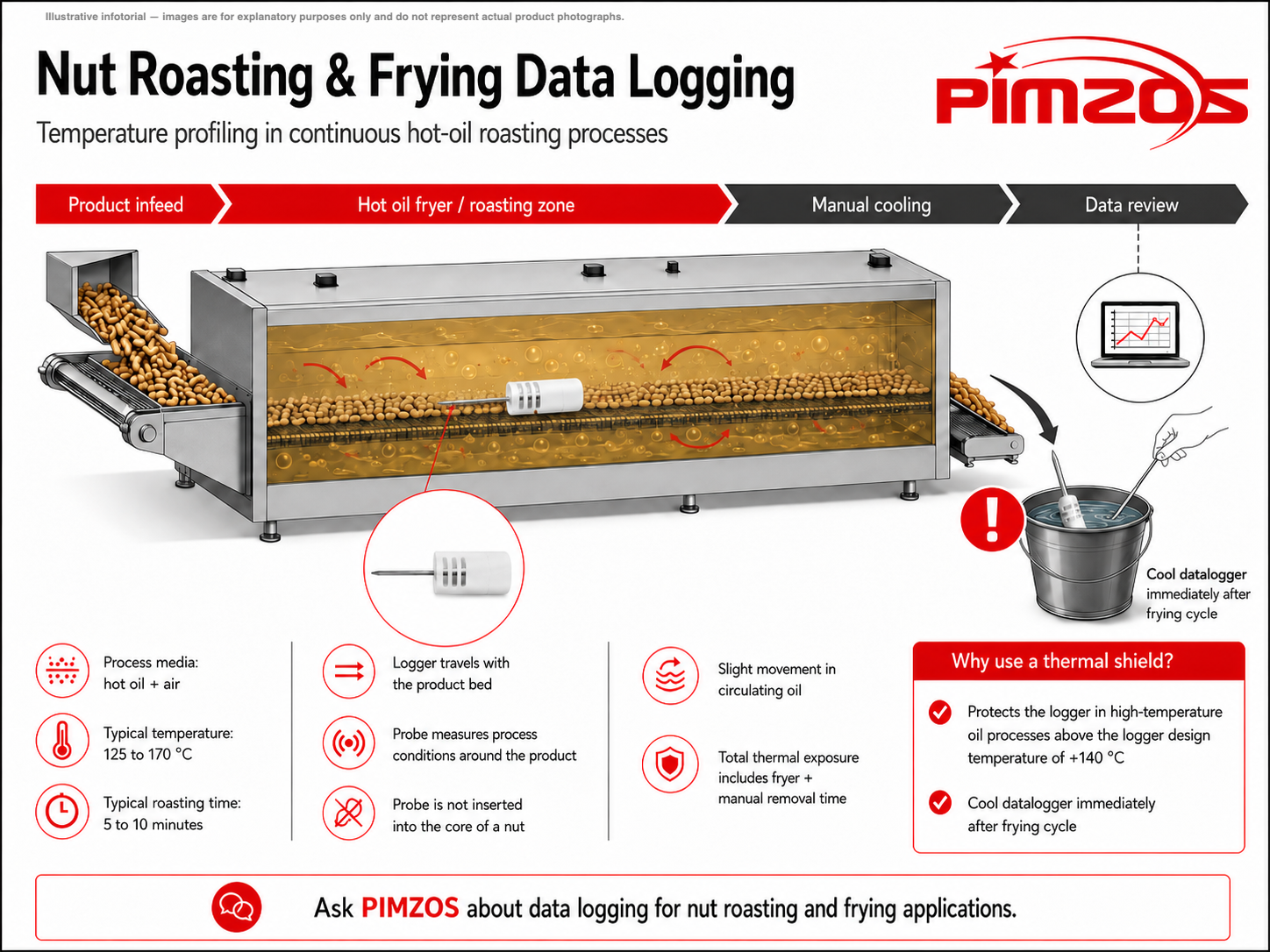
Temperature measurement during a continuous nut roasting process
In this application, the data logger is positioned between the nuts in the product bed and moves slightly together with the product as it travels through the fryer.
Typical process conditions for this type of application are:
- Process: continuous nut roasting / frying
- Process media: frying oil and air
- Temperature: approximately 125 °C to 170 °C
- Frying time: approximately 5 to 10 minutes
- Logger position: travelling within the product bed
- Movement: slight movement while hot oil circulates around the product
Why let the data logger travel with the product?
A fixed temperature sensor installed in the fryer measures the temperature at one specific location. This is not necessarily the same temperature profile that the product experiences while travelling through the complete process.
By allowing a data logger to travel together with the nuts, the process can be measured from the perspective of the product itself.
This can provide useful information about:
- temperature during the frying or roasting process
- temperature variations along the production path
- the actual thermal exposure of the product
- repeatability between production batches
- differences between the machine setpoint and the actual measured process temperature
The temperature probe does not need to be inserted into the product
For larger food products, a temperature probe can sometimes be inserted into the centre of the product. With nuts and coated nuts, this is generally not practical.
The objective is therefore not to measure the core temperature of one individual nut. Instead, the logger measures the temperature conditions surrounding the product while travelling with the product bed through the hot oil.
Why is a thermal shield required?
The normal operating temperature of a MadgeTech HiTemp140 data logger is up to +140 °C. Nut roasting and frying processes can operate above this temperature.
A suitable PTFE thermal shield slows down heat transfer to the data logger electronics and battery while allowing the temperature probe to remain exposed to the process.
This enables the data logger to operate for a limited period in processes above its normal operating temperature.
For more information about thermal shield operation, maximum exposure times and the difference between Flush and Vented configurations, see:
Thermal Shields for High-Temperature Data Logging
Using a Vented Thermal Shield in a moving application
During nut roasting, the data logger may move slightly between the nuts while hot oil circulates around the product and logger.
For applications involving movement, a Vented Thermal Shield can be particularly useful because it provides additional mechanical protection around the exposed temperature probe.
The most suitable configuration depends on the fryer design, available space, probe length, movement of the product and the complete temperature profile.
Cool the data logger immediately after the frying cycle
An important consideration is that the data logger can continue to absorb heat from the thermal shield after it has left the hot oil.
Whenever the process allows it, the data logger and thermal shield should therefore be cooled as soon as possible after the frying cycle.
One practical method is to place the complete thermal shield and logger in a water bath at approximately 25 °C immediately after the process. MadgeTech specifies cooling in a water bath at approximately 25 °C for at least 15 minutes following high-temperature exposure.
This prevents residual heat stored in the thermal shield from continuing to increase the internal temperature of the data logger after the frying process has finished.
The frying time is not the only important factor
A frying time of 5 to 10 minutes does not automatically mean that the total thermal exposure of the data logger is limited to 5 to 10 minutes.
The time required to remove the logger from the fryer and begin cooling must also be considered.
For this reason, the application should be evaluated using:
Process Temperature + Time in Hot Oil + Removal Time + Process Medium + Starting Temperature + Cooling Method
Example: nut roasting at 170 °C
Consider a process in which nuts are roasted in oil at approximately 170 °C for 8 minutes.
The data logger travels between the product and cannot necessarily be removed from the thermal shield immediately after leaving the fryer.
In this situation, the 8-minute frying time is only one part of the calculation. The time between leaving the hot oil and actually cooling the logger also contributes to the total thermal exposure.
This is why applications above 140 °C should always be evaluated using the complete temperature and time profile.
Temperature profiling for food processing
The same measurement principle can be useful for other continuous food-processing applications in which products are transported through hot oil or another high-temperature environment.
Examples include industrial frying processes, roasting processes and other food-production applications where a data logger can safely travel through the process together with the product.
Would you like to measure your nut roasting or frying process?
Every industrial fryer, roasting oven and production line is different. We therefore prefer to evaluate these applications using the actual temperature and time profile of the process.
Useful information to send us includes:
- minimum and maximum process temperature
- frying or roasting time
- total time the logger remains inside the machine
- process medium, for example frying oil and air
- available space inside the fryer
- information about product movement
- required probe length
- how the logger can be removed and cooled after the process
PIMZOS can help evaluate the application and select a suitable MadgeTech HiTemp140 data logger and thermal shield configuration.
Frequently Asked Questions about Data Logging in Nut Roasting
Can a data logger travel through hot frying oil?
With a suitable high-temperature data logger and thermal protection, this may be possible. Maximum temperature, exposure time, process medium and the complete temperature profile must all be evaluated.
Does the data logger measure the core temperature of the nut?
No. In this type of application, the probe is not inserted into an individual nut. Instead, it measures the temperature conditions surrounding the product while travelling through the process together with the nuts.
Why should the data logger be cooled immediately after frying?
The thermal shield absorbs heat during the process. This stored heat can continue to warm the data logger even after it has left the fryer. Rapid and controlled cooling limits this continued heating.
Can the same method be used for other food products?
Potentially, yes. Suitability depends on process temperature, duration, process medium, available space and the way the data logger moves through the production process.