



Thermal Shields for High Temperature Data Loggers
Thermal Shields for High-Temperature Data Logging
Measure temperatures in extreme environments while protecting your data logger.
Temperature data loggers are often used in ovens, autoclaves, food processing equipment and other industrial processes where the actual process temperature can exceed the normal operating temperature of the logger electronics and battery.
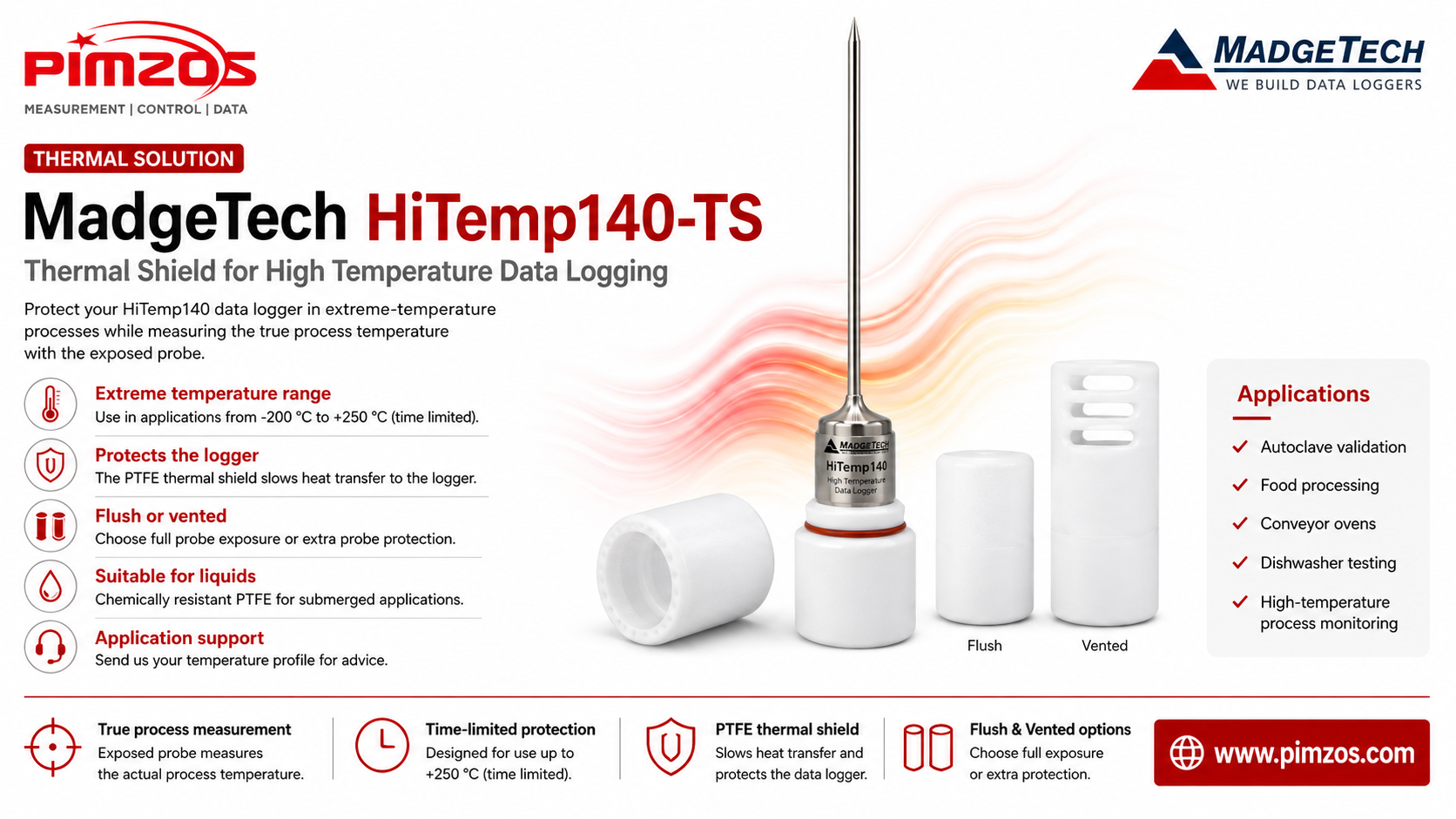
A thermal shield for a temperature data logger provides a practical solution. The MadgeTech HiTemp140-TS Thermal Shield protects compatible HiTemp140 data loggers against rapid heat transfer while the stainless-steel temperature probe remains exposed to the actual process.
Depending on temperature, exposure time and process medium, the HiTemp140-TS can be used in environments from -200 °C to +250 °C.
Important: at extreme temperatures the protection provided by the thermal shield is time limited. A thermal shield does not make the data logger permanently suitable for operation at +250 °C.
What does a thermal shield do?
A thermal shield creates a thermal barrier between the process environment and the body of the data logger.
The principle is simple:
Process temperature → exposed temperature probe → thermal shield → protected data logger
The temperature probe remains exposed and measures the actual process temperature. At the same time, the PTFE enclosure slows down the transfer of heat or cold to the electronics and battery inside the logger.
This makes it possible to perform measurements in environments that would otherwise be outside the normal operating temperature range of the data logger.
When do you need a thermal shield?
A thermal shield is particularly useful when the process temperature exceeds the normal operating temperature of the data logger.
Typical applications include:
- Industrial ovens
- Conveyor ovens
- Food processing
- Nut roasting and frying processes
- Autoclave validation
- Dishwasher testing
- Thermal process validation
- High-temperature process monitoring
The HiTemp140-TS is also submersible and can be used in suitable liquid applications.
How long can a data logger remain at high temperature?
This is one of the most important questions when selecting a thermal shield.
Between -40 °C and +140 °C, MadgeTech specifies indefinite exposure for the HiTemp140 when used with the HiTemp140-TS Thermal Shield.
Above +140 °C and below -40 °C, maximum exposure times apply. The allowable exposure time also depends on whether the thermal shield is used in air or liquid.
Maximum exposure times at high temperatures
| Process Temperature | Flush - Air | Flush - Liquid | Vented - Air | Vented - Liquid |
|---|---|---|---|---|
| +150 °C | 59 min | 34 min | 66 min | 40 min |
| +160 °C | 51 min | 29 min | 57 min | 34 min |
| +170 °C | 43 min | 25 min | 48 min | 29 min |
| +180 °C | 37 min | 23 min | 42 min | 26 min |
| +190 °C | 34 min | 20 min | 38 min | 23 min |
| +200 °C | 31 min | 18 min | 34 min | 21 min |
| +210 °C | 29 min | 17 min | 32 min | 19 min |
| +220 °C | 27 min | 16 min | 30 min | 18 min |
| +230 °C | 25 min | 15 min | 27 min | 17 min |
| +240 °C | 23 min | 14 min | 26 min | 16 min |
| +250 °C | 22 min | 13 min | 24 min | 15 min |
The difference between air and liquid is important. Heat transfer in a liquid can be considerably faster than in air, which reduces the allowable exposure time of the data logger inside the thermal shield.
Practical examples
Example 1: Can I measure for 30 minutes at 180 °C?
Process: 180 °C - 30 minutes - Air
- Maximum exposure with Flush Thermal Shield: 37 minutes
- Maximum exposure with Vented Thermal Shield: 42 minutes
Result: a 30-minute measurement is within the published exposure time for both versions.
Example 2: Can I measure for 35 minutes at 220 °C?
Process: 220 °C - 35 minutes - Air
- Maximum exposure with Flush Thermal Shield: 27 minutes
- Maximum exposure with Vented Thermal Shield: 30 minutes
Result: no. A 35-minute measurement exceeds the published exposure time for both versions.
Example 3: Can I measure in liquid at 200 °C?
Process: 200 °C - 15 minutes - Liquid
- Maximum exposure with Flush Thermal Shield: 18 minutes
- Maximum exposure with Vented Thermal Shield: 21 minutes
Result: a 15-minute measurement is within the published exposure time for both versions.
Flush or Vented Thermal Shield?
The HiTemp140-TS Thermal Shield is available in two configurations: Flush and Vented.
HiTemp140-TS Flush
With the Flush version, the temperature probe is fully exposed while the body of the data logger remains protected inside the thermal shield.
This provides maximum usable probe length and is particularly useful when the probe needs to:
- penetrate a product
- reach a specific measurement point
- be inserted deeper into the process
HiTemp140-TS Vented
The Vented version provides additional mechanical protection around the temperature probe.
It is particularly suitable when:
- the data logger may move during the process
- the complete assembly is submerged
- additional protection around the probe is required
The Vented version also provides slightly longer maximum exposure times in the manufacturer's published specifications.
The starting temperature is important
The published maximum exposure times assume that both the HiTemp140 data logger and the thermal shield start at approximately 25 °C.
This is important because the thermal shield works by slowing down heat transfer. If the shield is already warm before entering the process, less thermal capacity is available to protect the data logger.
For repeat measurements, allow both the thermal shield and data logger to return to approximately room temperature before beginning the next extreme-temperature measurement.
Cooling the data logger after a high-temperature measurement
Removing the thermal shield from an oven or hot process does not immediately stop heat transfer.
Heat stored inside the thermal shield can continue to heat the data logger even after the complete assembly has been removed from the process.
After high-temperature exposure, MadgeTech specifies two options:
- Remove the data logger from the thermal shield immediately, using appropriate precautions because the assembly may be very hot.
- Place the complete data logger and thermal shield in a water bath at approximately 25 °C for at least 15 minutes.
Do not simply leave a hot data logger inside the thermal shield and assume that the logger will immediately begin to cool.
What about ramping or changing temperature profiles?
Not every industrial process operates at one constant temperature.
A typical process may look like this:
25 °C → heat to 190 °C → hold at temperature → cooling phase
In this situation, simply looking at the maximum exposure time for 190 °C is not sufficient.
For applications involving a temperature ramp above 140 °C, or another complex temperature profile, the complete thermal process should be evaluated.
Important parameters include:
- Starting temperature
- Maximum process temperature
- Ramp-up time
- Time at maximum temperature
- Cooling time
- Total process duration
- Process medium such as air, steam, water or oil
Not sure whether a thermal shield is suitable for your process?
Selecting a thermal shield is not simply a matter of checking the maximum process temperature.
For a reliable application assessment, always consider:
Temperature + Exposure Time + Process Medium + Complete Temperature Profile
Send PIMZOS your temperature profile and process details. We can help determine whether the HiTemp140 with Thermal Shield is suitable for your measurement and help select the correct data logger, probe and thermal shield configuration.
Useful information to send us includes:
- Minimum and maximum temperature
- Total process duration
- Time above 140 °C
- Heating and cooling times
- Process medium: air, steam, oil, water, etc.
- Required probe length
- Required measurement position
Frequently Asked Questions about Thermal Shields
Can a temperature data logger measure at 250 °C?
Yes. With a suitable HiTemp140 data logger and HiTemp140-TS Thermal Shield, measurements can be performed in environments up to 250 °C, but only for a limited period.
At 250 °C, the published maximum exposure time in air is 22 minutes with the Flush shield and 24 minutes with the Vented shield.
Does the thermal shield affect the measured temperature?
The thermal shield protects the body of the data logger. The temperature probe remains exposed to the process and measures the actual process temperature.
Can the HiTemp140 Thermal Shield be submerged?
Yes. The HiTemp140-TS is designed to be submersible. Different maximum exposure times apply to liquid applications.
What is the HiTemp140-TS Thermal Shield made from?
The HiTemp140-TS enclosure is manufactured from PTFE.
Can I use a temperature data logger with a thermal shield in an oven?
Yes. Conveyor ovens and other high-temperature industrial processes are typical applications. The allowable measurement duration depends on the process temperature and the complete temperature profile.
Can the thermal shield be reused?
Yes. The thermal shield is reusable. For repeat extreme-temperature measurements, both the shield and data logger should return to approximately room temperature before the next measurement when using the published exposure-time specifications.
High-temperature data logging support from PIMZOS
High-temperature data logging requires more than selecting a logger with the highest possible temperature specification.
The correct solution depends on the complete process, including temperature, duration, media, probe position and cooling conditions.
Contact PIMZOS with your application details and temperature profile. We will help you select the appropriate HiTemp140 data logger and thermal shield configuration.